Home     Daily Blog     Galleries     Maps     Contact

Showing posts with label Alabama. Show all posts

Thursday, April 14, 2022

Welcome to Sequoyah Country

Welcome to Sequoyah Country

Sequoyah Caverns closed for good on Labor Day, 2013. If you need to read about that, look here:
www.flickr.com/photos/brent_nashville/9536698948/in/photo...

The way of getting to Sequoyah Caverns is to travel along highway US11 around Valley Head, AL and then turning at a big billboard which points the way. After travelling a few hundred feet down a county road, you see this barn which reaffirms you are on your way.

The Painting of Sequoyah seen here is similar to other renderings seen at the tourist attraction.

The other side of this barn is for people leaving Sequoyah Country, and gives you the options for which way to go on US11: www.flickr.com/photos/brent_nashville/7942607164/

Saturday, April 9, 2022

Friday, September 17, 2021

Visit Sequoyah Caverns barn - Valley Head, AL

Visit Sequoyah Caverns barn

Sequoyah Caverns is a cave and now-closed tourist attraction in DeKalb County, AL. When the cave first opened commercially, they hired the famous Rock City barn painter Clark Byers to run the operation. I suppose barn painting was still a hobby of his as he painted several of these in the area. (By my count, there are 8 in and around the county.) The Barn seen here is located near the town of Valley Head, AL. Highway AL117 as it heads west out of town curves around a bend where this barn is visible. The last line mentions the barn is 6 miles away on US11. If you look closely you can see an older message where the paint is starting to show through. There's an old white border that goes all the way around the message and in cursive, the word SEE in the top right corner. Maybe the Sequoyah message changed over the year, or perhaps it used to be a Rock City barn before Sequoyah opened up in the 1960s.

Wednesday, August 11, 2021

Murrah-Maples-Pryor House ca. 1838 - Athens, AL

Murrah-Maples-Pryor House ca. 1838

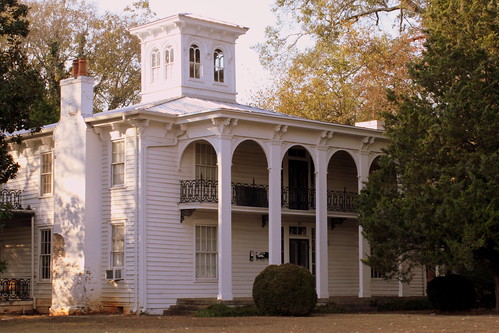
Also known as the Luke Pryor house or the Frances Snow Pryor house, this home is located at 405 N. Jefferson St. in Athens, AL. It is stop #15 on Limestone County's Antebellum trail.

Luke Pryor became the owner of this home in 1854. Pryor was an Alabama Congressman who helped get the Tennessee and Alabama Central Railroad built. The first locomotive to run on that line was named in his honor. Pryor became a US Senator in 1879.

Thursday, July 15, 2021

The Little Lion of Big Springs Park - Huntsville, AL

The Little Lion of Big Springs Park - Huntsville, AL

According to the marker:
The Little Lion of Big Springs Park
Gift of J.F. Hummel
to the park for
"As long as children...play in the park"
Circa 1900
Refurbished and restored by
The Historic Huntsville Foundation
August 7, 1995

Tuesday, April 20, 2021

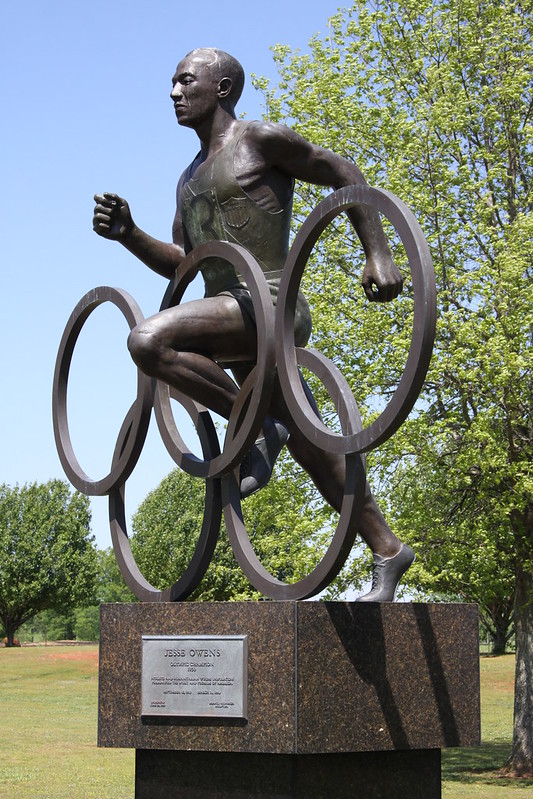
Jesse Owens Olympic Champion Statue

Jesse Owens Olympic Champion Statue

The Jesse Owens Museum in Oakville, AL is a tribute to the Olympic Track and Field great. He captured four gold medals at the 1936 Berlin Olympics shattering Hitler's Aryan supremacy theory. The museum pays tribute to his athletic and humanitarian achievements. Also on the grounds of the park are a replica of his birth home, a bronze statue, 1936 Olympic torch replica, a broad jump pit where you can test your own ability, and the Gold Medal tree.

This statue by Branko Medenica was unveiled in 1996, timed for the 1996 Atlanta Olympic torch could pass by during the ceremony. The Olympic rings represent a finish line that he is crossing but also represents many of the racial barriers he overcame. Learn more here:
jesseowensmemorialpark.com/wordpress1/statue

Jesse Owens Olympic Champion Statue

Monday, March 15, 2021

Decatur, AL Train Depot

Decatur, AL Passenger Depot

From Wikipedia:
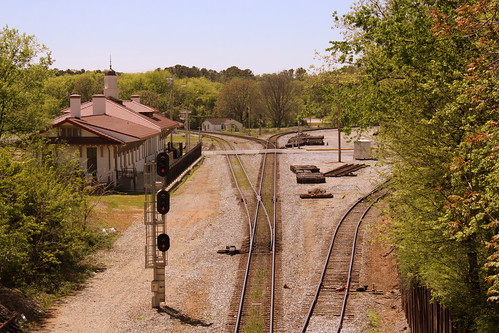
The Southern Railway Depot is a historic building in Decatur, Alabama. The depot was built in 1904–05 along the Southern Railway line. Decatur had become a transportation hub of North Alabama by the 1870s, with its connections to the Tennessee River, the east-west Tuscumbia, Courtland and Decatur Railroad (later operated by the Memphis and Charleston Railroad and the Southern Railway), and the north-south Louisville and Nashville Railroad. It functioned as a passenger station until 1979, when Amtrak cancelled its Floridian service. The station is built of brick painted white, with quoins on the corners. The building has a rectangular central section with narrower wings stretching along the tracks. The central section has a hipped roof, while the wings have gable roofs; both have deep eaves with decorative brackets. The main entrance is covered by a porte-cochère with arched openings. The depot was listed on the National Register of Historic Places in 1980.

Here is a view from the pedestrian bridge which crosses the tracks:

Decatur, AL Passenger Depot (Pedestrian bridge view)

Decatur, AL Passenger Depot

Sunday, February 28, 2021

Thursday, January 28, 2021

Huntsville Moonwalk

Huntsville Moonwalk

In downtown Huntsville next to Constitution Village is the Huntsville Moonwalk. The footsteps of astronaut Alan B. Shepard are preserved along with the steps of several local kids. This was dedicated on the 25th Anniversary of the Apollo Moon Landing on July 20, 1994.

Friday, January 22, 2021

Desoto Falls

Desoto Falls

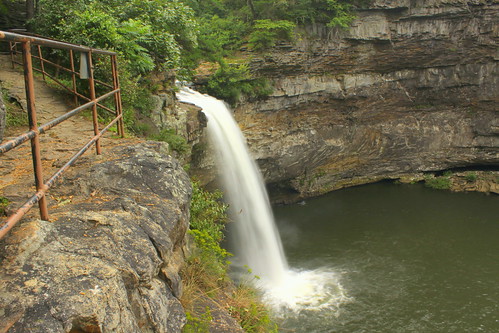
A fork of the Little River plunges 104 feet into the pool below at one of Lookout Mountain's most accesible waterfalls. Desoto Falls is named after Spanish explorer Hernando de Soto. De Soto's exploration travelled through the area, likely south of here, but according to legend, some artifacts were found near the falls. According to more folklore, it is suggested that caves in the steep bluff below the falls were part of a fort built by Welsh explorers in 1170, and while most archaeologists and historians find no evidence of this, it's tough to prove something didn't happen that long ago. Today, the waterfall is part of Desoto State Park, which contains several waterfalls. Upper Desoto Falls is just a few feet from here, and an old 1920's hydroelectric dam is just upstream from that. A short paved path leads to the overlook where you can get this view of the falls. Unless you know someone who lives across the canyon, this is the best view most people can get of these falls.

Saturday, December 12, 2020

Coca-Cola mural - Decatur, AL

Coca-Cola mural - Decatur, AL

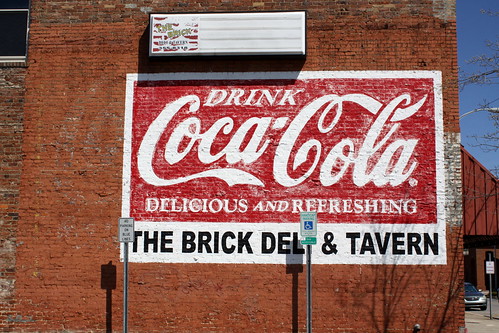
Located at the Brick Deli & Tavern, this Coke mural is painted atop a faded coke mural.

Delicious and Refreshing

Monday, November 16, 2020

Limestone County Courthouse - Athens, AL

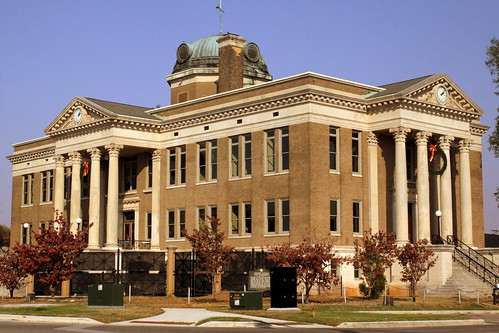
The featured building in the Athens Courthouse Square Commercial Historic District is the Limestone County Courthouse, built in 1919 in Neoclassical style with Palladian influences. The district was listed on the National Register of Historic Places in 1997 and the Alabama Register of Landmarks and Heritage in 2012.

On the November day this photo was taken in 2016, a large Christmas wreath was displayed along each side. There is also some construction work being done on the grounds.

Limestone County Courthouse - Athens, AL

Tuesday, November 3, 2020

Kreme Delight neon sign - Athens, AL

Kreme Delight neon sign - Athens, AL

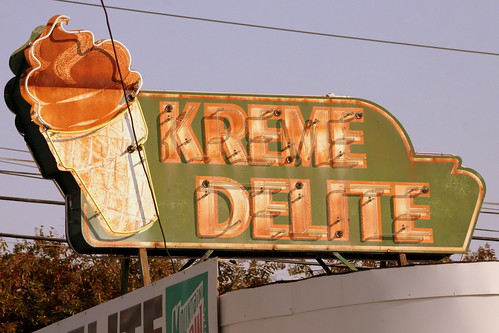
This old fashioned burger and ice cream restaurant seemed to be a popular spot in Athens, AL

Wednesday, October 21, 2020

Old State Bank Building - Decatur, AL

Old State Bank Building - Decatur, AL

From wikipedia:
The Old State Bank is a historic Jeffersonian-style bank building in Decatur, AL. It was recorded by the Historic American Buildings Survey in 1934 and 1935. It was added to the National Register of Historic Places on March 24, 1972, due to its architectural significance.

The Decatur branch of the Alabama State Bank opened its doors on July 29, 1833. It was authorized by the Alabama General Assembly in 1830 to be one of three branches of the Alabama State Bank. After outstanding debts of over $1 million were unable to be reformed the Decatur branch franchise was revoked. The building remained vacant until the 1860s when it was one of three buildings that survived the Civil War in Decatur. During the Battle of Decatur, the bank was used as headquarters for the Union forces in the area, and was also used as a hospital while battles raged outside. Such evidence of the battle remains in the form of visible bloodstains in one of the three vaults, slugs from musketfire, and Minie balls are still clearly seen in the walls of the building.

In 1881, the First National Bank opened its doors in the Old State Bank building. But, when First National Bank completed its new office in 1902, the bank building was used as a residence and office by Dr. J.Y. Cantwell. After signs of deterioration began to show themselves, Cantwell's grand niece, Mrs. W. B. Edmundson, deeded the building over to the City of Decatur in 1933. Management of the structure was vested to an eight member Board of Governors. The petition for restoration was presented to the Civil Works Administration and restoration commenced. Being one of only a handful of local buildings to survive the destruction of the American Civil War, and after going through the many changes over the years, the Old State Bank has become a symbol of historical significance.

By the year 1946, the building was deeded by its owner to the Morgan County American Legion, Post No. 15. At some point, the original bank building was completely obscured by a brick facade which also enclosed the front portico and columns. The appearance was simply a huge, ugly, brick warehouse and, by the early Seventies, the original history was long forgotten. As part of a plan to remove aging, blighted buildings, a demolition crew was contracted to tear down the old building with a wrecking ball. It was soon obvious that something unusual was present when the wrecking ball could tear right through the front wall at some places, but the heavy ball bounced off other spots. The invincible spots were found to be the five limestone columns hidden behind bricks for generations. (A few of the columns still carry wrecking ball scars.) The project to demolish the old, blighted warehouse quickly transformed into restoring this centerpiece of a newly formed historical district.

In 1972, the Old State Bank was named to the National Register of Historical Places at the age of 139 years. Three years later, in 1975, the American Legion, Post No.15, donated the Old State Bank building to the City of Decatur, AL. Plans for restoration were put together in the year 1976, as the bank turned 143 years old, and was put under the control of the Old Bank Board members. Restoration of the bank was finished in the year 1983, at the age of 150. In 1984, a curator was appointed, and daily tours were implemented. A second wave of detailed restoration was undertaken in the years of 1995-1996, and was led by noted preservation architect, Harvie Jones. Funding was provided by the Alabama Historical Commission, the City of Decatur, and the Old Bank Board of Directors. The City of Decatur commemorated the bank's 175th anniversary in 2008.

The architecture of the bank shows the influence of Thomas Jefferson's fusion of Palladianism with Roman temple forms. The five limestone columns across the front weigh 100-150 tons each and were mined in nearby Trinity. The pentastyle portico is highly unusual.

Old State Bank Building - Decatur, AL Old State Bank Building fountain - Decatur, AL Old State Bank Building - Decatur, AL

Wednesday, September 16, 2020

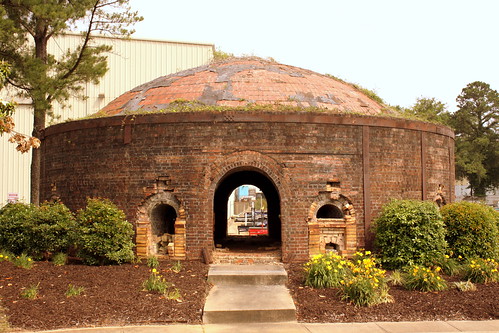
Historic Beehive Brick Kiln - Decatur, AL

Historic Beehive Brick Kiln - Decatur, AL

In the early 1800s some of the finest bricks in America came from Brickyard Landing in Decatur, AL. Originally, there were several of these beehive Brick Kilns, but this is the only one not removed. Surprisingly, there was not a historic marker here, but I hear a developer is pushing to get this added to the National Register of Historic Places.

Saturday, September 12, 2020

Peach Park - Clanlton, AL - Pose with a giant peach

Peach Park - Clanlton, AL - Pose with a giant peach

Peach Park is an old-fashioned tourist attraction in Clanton, AL where US31 and I-65 meet. Peaches are usually associated with Georgia, but there are several Peach and produce markets in the area between Birmingham and Montgomery. Peach Park tries to set itself apart with things like this peach statue in a garden, a lighthouse, a caboose, a Playground set around a replica barn. My wife bought some home-made cantaloupe ice cream which she calls the best she's ever had.

Monday, August 24, 2020

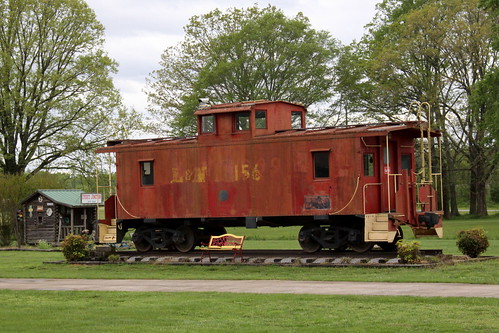
L&N Caboose #156

L&N Caboose #156

L&N Caboose #156 appears to be on private property but easy to view in Ardmore, AL. The spot labelled as Steve's Junction is along 7th St. fairly close to the live tracks.

Thursday, August 20, 2020

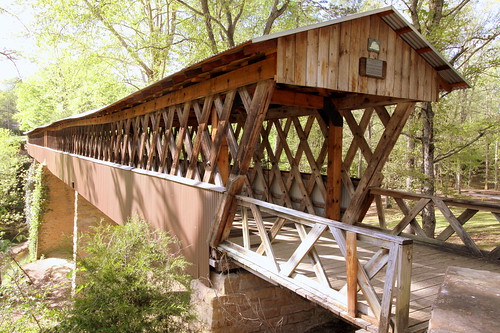
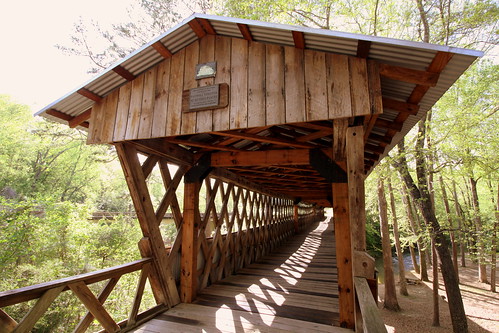
Clarkson Covered Bridge - Near Cullman, AL

Clarkson Covered Bridge

From Wikipedia:
en.wikipedia.org/wiki/Clarkson%E2%80%93Legg_Covered_Bridge

The Clarkson–Legg Covered Bridge, more simply known as Clarkson Covered Bridge, is a county-owned wooden covered bridge that spans Crooked Creek in Cullman County, Alabama, United States. It is located at Clarkson Covered Bridge Park on County Road 1043 (CR 1043) off U.S. Route 278 near the community of Bethel, about 8 miles (13 km) west of Cullman.

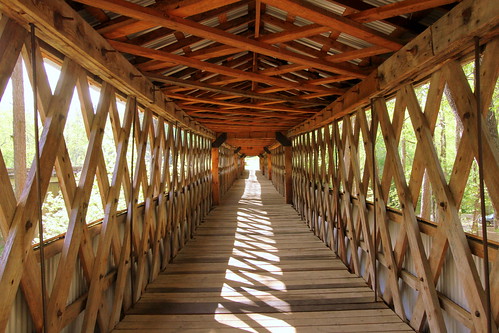
Originally built in 1904, the 270-foot (82-meter) bridge (although some other sources say the bridge is only 250 feet long, including NRHP) is a Town Lattice truss construction over four spans. The Clarkson–Legg Covered Bridge was listed on the National Register of Historic Places on June 25, 1974. It is currently the second-longest existing covered bridge in Alabama and one of the longest in the United States. The bridge is maintained by the Cullman County Commission.

The Clarkson–Legg Covered Bridge was constructed over Crooked Creek in 1904 on property owned by local mail carrier James W. Legg at the cost of $1,500. It was originally named the Legg Covered Bridge after the landowner, who saw the need for transportation improvement in the area and even supplied much of the materials. A flood destroyed half of the bridge in 1921. Most of the pieces were recovered downstream, and the bridge was able to be rebuilt the following year, with help from a contractor hired by Cullman County, also at a cost of $1,500. The covered bridge remained in service to motor traffic until 1962, when it was bypassed by a nearby concrete bridge. As part of the American Bicentennial Project, the Clarkson–Legg Covered Bridge was restored by the Cullman County Commission in 1975, along with a gristmill and log cabin also located at Clarkson Covered Bridge Park. A number of activities are now held at the park, including an annual event by the county called Old-Fashioned Days.

On Christmas Day of 2015, many of the paths and walkways within Clarkson Covered Bridge Park were damaged due to flooding after 8 inches (20 cm) of rain fell in a 24-hour period. The covered bridge itself was unharmed. Although the flood was not as significant as the one which occurred in 1921, it did require the park to be closed to the public while repairs were made. The park reopened on January 13, 2016.

Clarkson Covered Bridge northwest end

Clarkson Covered Bridge inside

Clarkson Covered Bridge (alt view)

Thursday, July 9, 2020

Home of Hank Williams Caboose

Home of Hank Williams Caboose

The Boyhood home of Hank Williams is in Georgiana, AL and this caboose is on the property.

Friday, July 3, 2020

Brown Chapel A.M.E. Church - Selma, Alabama

Brown Chapel A.M.E. Church - Selma, Alabama

From Wikipedia:
Brown Chapel A.M.E. Church is a church in Selma, AL. This church was a starting point for the Selma to Montgomery marches in 1965 and, as the meeting place and offices of the Southern Christian Leadership Conference (SCLC) during the Selma Movement, played a major role in the events that led to the adoption of the Voting Rights Act of 1965. The nation's reaction to Selma's "Bloody Sunday" march is widely credited with making the passage of the Voting Rights Act politically viable in the United States Congress.

It was added to the Alabama Register of Landmarks and Heritage on June 16, 1976 and later declared a National Historic Landmark on February 4, 1982.

For more of the story:
npgallery.nps.gov/pdfhost/docs/NHLS/Text/82002009.pdf