Home     Daily Blog     Galleries     Maps     Contact

Showing posts with label train tracks. Show all posts

Friday, January 28, 2022

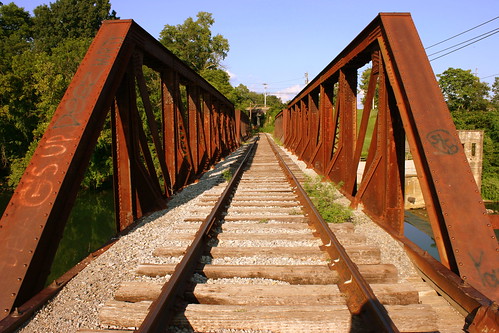
Cheatham County Bicentennial Trail Bridge

Cheatham County Bicentennial Trail Bridge (Ver. 3)

This bridge was originally built in 1901 by the Tennessee Central Railway as they extended their rail line from Nashville west to Clarksville. Around 1990, the tracks west of Ashland City were abandoned and soon many people wanted to convert the old railbed and this bridge to a pedestrian trail. With a partnership between the Rails-to-Trails Conservancy and the Cheatham County Parks Department, the Cumberland River Bicentennial Trail was built and it utilized the old bridge. (The trail parallels the Cumberland River but actually crosses Sycamore Creek.) The iron Parker through truss bridge with a length of 550 ft. was built by American Bridge Co.

Monday, March 15, 2021

Decatur, AL Train Depot

Decatur, AL Passenger Depot

From Wikipedia:
The Southern Railway Depot is a historic building in Decatur, Alabama. The depot was built in 1904–05 along the Southern Railway line. Decatur had become a transportation hub of North Alabama by the 1870s, with its connections to the Tennessee River, the east-west Tuscumbia, Courtland and Decatur Railroad (later operated by the Memphis and Charleston Railroad and the Southern Railway), and the north-south Louisville and Nashville Railroad. It functioned as a passenger station until 1979, when Amtrak cancelled its Floridian service. The station is built of brick painted white, with quoins on the corners. The building has a rectangular central section with narrower wings stretching along the tracks. The central section has a hipped roof, while the wings have gable roofs; both have deep eaves with decorative brackets. The main entrance is covered by a porte-cochère with arched openings. The depot was listed on the National Register of Historic Places in 1980.

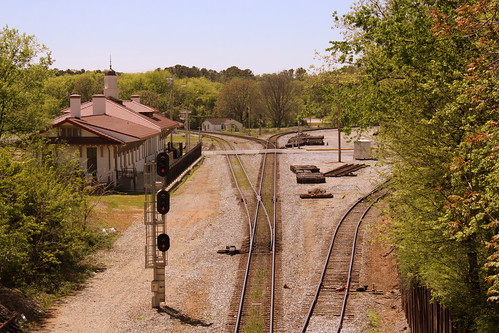
Here is a view from the pedestrian bridge which crosses the tracks:

Decatur, AL Passenger Depot (Pedestrian bridge view)

Decatur, AL Passenger Depot

Monday, September 7, 2020

Railroad Crossing at the Cream City district (Night) - Cookeville

Railroad Crossing at the Cream City district (Night) - Cookeville

The area around the Tennessee Central train depot is a well preserved historic district in Cookeville. The depot was the crown jewel of the TC system, and several manufacturing warehouses opened in the surrounding area. The most prominent was the Cream City Ice Cream plant. Cream City went out of business, but their spectacular sign is well preserved and lit on special occasions.

To see more pictures of the neon sign, Look here!

Tuesday, June 9, 2020

Railroad Crossing at the Cream City district (Daytime) - Cookeville

Railroad Crossing at the Cream City district (Daytime) - Cookeville

The area around the Tennessee Central train depot is a well preserved historic district in Cookeville. The depot was the crown jewel of the TC system, and several manufacturing warehouses opened in the surrounding area. The most prominent was the Cream City Ice Cream plant. Cream City went out of business, but their spectacular sign is well preserved and lit on special occasions.

To see more pictures of the neon sign, Look here!

Thursday, March 24, 2016

Railroad Bridge over Barren Fork - McMinnville, TN

Railroad Bridge over Barren Fork - McMinnville, TN

I can't find too much information on how old this bridge is, but there was a railroad line that ran from McMinnville to Tullahoma before the Civil War. During the war, the north destroyed every bridge on this line between the two cities, including the one that crossed the Barren Fork River, which I assume is at this same spot.

Originally, there were multiple mills up and down the river through here, but in 1902, a hydroelectric dam was built, but is not in use anymore. According to a photo on the historical marker nearby, this bridge was already here when the dam was built.

At one time, the bridge was used by NCStL, and then by L&N, and then by CSX. Today, the tracks are used by the short line Caney Fork & Western Railroad, which connects CSX from Tullahoma to Manchester and Sparta.

Friday, December 11, 2015

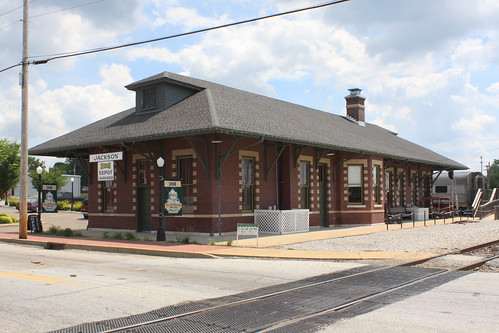
Jackson, TN NCSTL Depot

Jackson, TN NCSTL Depot

The brick building in Jackson was built in 1907 and is now open as a museum.

Friday, December 4, 2015

Gilley's Hotel - Bull's Gap, TN

The Bull's Gap website has the full story on this railroad hotel which was rebuilt in 1884: www.bullsgaptn.us/index.php?option=com_content&view=a...

the Tennessee Preservation Trust added this to the 2014 Ten in Tennessee: a yearly list of threatened historic sites. Here is their write-up:
Historical Significance: Gilley’s Hotel is listed as a contributing resource of the Bulls Gap Historic District, which is listed in the National Register of Historic Places. It is described in Section 7 of the National Register nomination at items 29 and 30. The East Tennessee and Virginia Railroad constructed the first railroad tracks to serve northeastern Tennessee in the 1850s. The tracks came through what is now Bulls Gap. The Smith Hotel was built at that time to serve passengers and railroad employees. The original hotel was destroyed by fire and the building that stands today was constructed in its place. Rufus Henry Gilley acquired the property in the early 1900s and it was at that time that the building became known as Gilley’s Hotel. It stands as a monument to, and a reminder of, an era when the railroad served as the primary mode of passenger transportation in the United States. Gilley’s Hotel is associated with historic events that have made a significant contribution to the broad patterns of the history of Bulls Gap.
www.tennesseepreservationtrust.org/ten-in-tn/2014-ten-in-...

Saturday, November 22, 2014

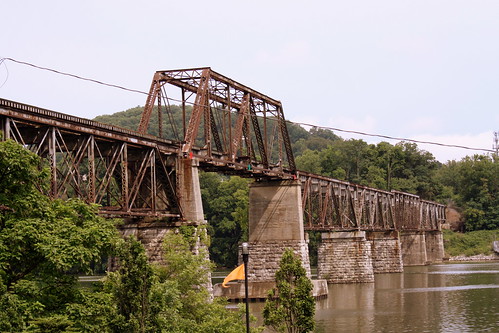
Norfolk Southern Tennessee River Bridge - Knoxville

Norfolk Southern Tennessee River Bridge - Knoxville

Located in downtown Knoxville, this railroad bridge now used by Norfolk Southern has elements dating back to the Civil War, but has been rebuilt several times.

The stone piers and approaches are the oldest element of the bridge, dating back to the 1850s. Wooden spans were completed in 1867. In 1903, wooden spans were replaced with a steel trestle. It underwent a major rebuild in 1940. A tugboat hit one of the piers in 1993 and that pier was fortified. The center span of the bridge is a Pratt through truss and the other segments are Warren deck trusses.

The original builder of the bridge was Knoxville & Charleston Railroad which chartered in 1852. In the 1870s, they became the Knoxville & Augusta Railway. In 1890, they were bought out by East Tennessee, Virginia and Georgia Railway. Then, in 1894 they were bought out by Southern Railway.

Monday, January 27, 2014

Frankfort Railroad Tunnel

Frankfort Railroad Tunnel

The 518 foot Franklin Tunnel was built by the Lexington & Frankfort Railroad in 1849. Most everything on the east side of the old part of town is up an old hill, including Main Street which is above the tunnel. However, the tracks follow the river out of town. (The old Kentucky State Arsenal is up there, too and can barely be seen through the trees.)

The tunnel today is part of the RJ Corman line as two trains a day pass through here. Many older tunnels get bigger over time and this one is no exception. RJ Corman acquired the line in 2004 and raised the tunnel in 2007 from a height of 16' to 20.5'.

Saturday, September 28, 2013

The Old Railroad Bridge: Gate to Block the tracks - Florence, AL

The Old Railroad Bridge View #5 Gate to Block the tracks - Florence, AL

The Old Railroad Bridge dates back over 140 years as an important crossing of the Tennessee River between Florence and Sheffield in The Shoals area of Alabama.

Back in 1840, the first bridge at this location opened. It significantly damaged by tornadoes and storms all through the 1850's and eventually that bridge was destroyed during the Civil War.

In 1870, the Memphis & Charleston Railroad decide to build another bridge at this spot. Over the next 120 years, there is quite a lengthy history about who got to use the bridge and changes to the bridges configuration. I'll hit some of the highlights, but below I'll link to a thorough history.

Originally, there was not a method for tall ships to go through, so a drawbridge was installed in 1872 along the northern end. A new drawbridge was installed in 1906. In 1948, the drawbridge was replaced with a turn span was installed. (When the bridge was open to tall ship, this span pivoted or rotated counter-clockwise and had stone piers to rest upon.) In 1962, this segment was changed again to a lift bridge, raising to 350 feet of clearance over the water. In 1988, all railroads abandoned the bridge and the lift section was completely removed.

This bridge not only carried railroads on the top, but also had a lower deck for vehicular traffic. This closed in 1939 with the opening of the O'Neal Bridge.

Other railroads that used this bridge were Virginia & Georgia; Nashville, Florence & Sheffield; L&N; Southern; Around 1903, a streetcar service also used the rails to get passengers from one side to the other and it lasted until 1933.

The complete history is here:
www.oldrailroadbridge.org/index.php?option=com_content&am...

In 1990, a preservation society began in an effort to restore the bridge. The old railroad bed leading to the upper portion of the bridge now has a large gate in front of it, so you can look across it, but go no further. Down below, the access area was cleaned up and the wood that had been rotting for over 50 years was replaced. Today, this lower deck is a pedestrian bridge where you can walk about 1500 feet to where the segment is missing, and then you have to turn around.

Here are all 9 photos in my set
www.flickr.com/photos/brent_nashville/tags/1870railroadbr...

Finally, the Library of Congress has some photos of this bridge dating back to 1976
www.loc.gov/pictures/search/?q=Photograph:%20al1320&f...

Thursday, June 27, 2013

CSX Caboose 903913 - Etowah, TN

CSX Caboose 903913 - Etowah, TN

With as many cabooses I've seen over the years, and as many CSX trains I've seen over the years, it occurred to me as I was photographing this one on the other side of the tracks that I'd never seen a CSX caboose before. It makes sense, I suppose. The need for cabooses had already diminished by the time CSX was formed in 1986, but it makes you wonder how many of them are out there.

Flickr user hunter1828 has this photo of what it looked like when it was fresh and new:
www.flickr.com/photos/hunter1828/6457969447/in/faves-bren...

Friday, March 15, 2013

Cowan TN typical brochure view

Cowan TN typical brochure view

The sign reads:
COWAN, TENNESSEE
Named in honor of Major John Cowan, early pioneer settler Major William Russel first settled here in 1800, his home serving as the first Court House 1807-1814

1848-1854:
N&C Railroad constructed the world's longest tunnel and steepest grade railroad

1855:
9 mi. spur line to Sewanee Mountain completed by Sewanee Mining Company.

1863-1864:
Confederate and Federal Armies camped in Cowan.

Failure of Confederate Forces to destroy the tunnel provided General Sherman with a direct line of supply for his march through Georgia.
Erected 1974

Wednesday, January 2, 2013

Rock Island Railroad Bridge

Train Bridge

Train bridge over the Caney Fork River which is on the border of Warren and White county. At this spot, the street forms a bridge over the tracks creating this vantage point. The tracks are live and today used by the short line Caney Fork & Western Railroad.

Wednesday, November 14, 2012

Curving Tracks of the Nashville Gulch

Curving Tracks of the Nashville gulch

If you are taking a standard picture of Union Station from the Broadway bridge, and you turn around, this is what you see.

Thursday, October 4, 2012

The Old Railroad Bridge to Nowhere

The Old Railroad Bridge View #3 Tracks to Nowhere - Florence, AL

The Old Railroad Bridge dates back over 140 years as an important crossing of the Tennessee River between Florence and Sheffield in The Shoals area of Alabama.

Back in 1840, the first bridge at this location opened. It significantly damaged by tornadoes and storms all through the 1850's and eventually that bridge was destroyed during the Civil War.

In 1870, the Memphis & Charleston Railroad decide to build another bridge at this spot. Over the next 120 years, there is quite a lengthy history about who got to use the bridge and changes to the bridges configuration. I'll hit some of the highlights, but below I'll link to a thorough history.

Originally, there was not a method for tall ships to go through, so a drawbridge was installed in 1872 along the northern end. A new drawbridge was installed in 1906. In 1948, the drawbridge was replaced when a turn span was installed. (When the bridge was open to tall ship, this span pivoted or rotated counter-clockwise and had stone piers to rest upon.) In 1962, this segment was changed again to a lift bridge, raising to 350 feet of clearance over the water. In 1988, all railroads abandoned the bridge and the lift section was completely removed.

This bridge not only carried railroads on the top, but also had a lower deck for vehicular traffic. This closed in 1939 with the opening of the O'Neal Bridge.

Other railroads that used this bridge were Virginia & Georgia; Nashville, Florence & Sheffield; L&N; Southern; Around 1903, a streetcar service also used the rails to get passengers from one side to the other and it lasted until 1933.

The complete history is here:
www.oldrailroadbridge.org/index.php?option=com_content&am...

In 1990, a preservation society began in an effort to restore the bridge. The old railroad bed leading to the upper portion of the bridge now has a large gate in front of it, so you can look across it, but go no further. Down below, the access area was cleaned up and the wood that had been rotting for over 50 years was replaced. Today, this lower deck is a pedestrian bridge where you can walk about 1500 feet to where the segment is missing, and then you have to turn around.

Here are all 9 photos in my set
www.flickr.com/photos/brent_nashville/tags/1870railroadbr...

Finally, the Library of Congress has some photos of this bridge dating back to 1976
www.loc.gov/pictures/search/?q=Photograph:%20al1320&f...

Tuesday, September 25, 2012

Post Card Tuesday: Nashville's Union Station


This Post card of one of Nashville's most popular landmarks dates back to 1902.

The depot was built in 1900, just a couple of years before the post card was made, in a castle-like late-Victorian Romanesque Revial style. The clock on the tower was one of the earliest digital clocks, but is now a traditional clock. Atop the tower used to be a 3D statue of the Roman god Mercury, but was kncoked off in a windstorm in the 50s. In the mid-90s, a flat Mercury was put in its place. That one was knocked off in the 98 tornado, but was replaced again.

The station became vacant in 1979 after train service was discontinued. It opened as a luxury hotel in March of 1990, and is now a Wyndham hotel.

An architecturally significant train shed used to be located right next to the station, but it's deteriorating condition, plus lack of any conceivable use led to it being demolished a few years ago, which caused Union Station to lose its status as a National Historic Landmark.

Most views of Union station (like the one above) tend to look from the front across the street (broadway). This is a fuller view of the building from the side, taken from the Broadway viaduct.

Union Station