Home     Daily Blog     Galleries     Maps     Contact

Showing posts with label Andrew Jackson. Show all posts

Wednesday, July 7, 2021

The Hermitage Church

The Hermitage Church

In 1823, Andrew Jackson donated the land, a portion of the funds, and the labor of his slaves to build this simple church. There's little doubt that it was the encouragement of Rachel Jackson. Originally non-denominational, in 1832, the Hermitage church joined the Presbyterian church. In 1838, he officially joined this church fulfilling his promise to Rachel that he would become a member after he retired from politics.

The church remained active until 1965 when it was gutted by fire. Then the Ladies' Hermitage Association donated nearby land for a new building and the LHA rebuilt it to look as it did in 1839.

See the historic markers here:
seemidtn.com/gallery/index.php?album=historical-markers%2...


On a personal note, I took this photo in 2019. I had been here once before about 30 years prior. At the time, my dad as a Music Professor at Lipscomb University ran an ensemble which performed Medieval and Renaissance music. His group had a performance here. Upon arrival, they learned there was no working electricity. All of the musicians had to read their music from candle-light.

Monday, April 26, 2021

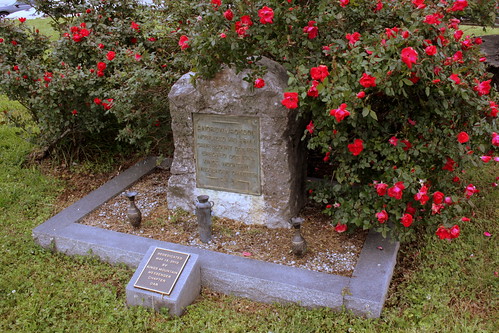
Andrew Jackson Camp Blount marker - Fayetteville, TN

Andrew Jackson Camp Blount marker - Fayetteville, TN

Andrew Jackson mobilized his army - Camp Blount - Oct. 1813 - Erected Oct 1913, Kings Mountain Messenger Chapter D.A.R.

This marker is located on the south side of Fayetteville along US231/431 in front of the WalMart. The actual Camp Blount is being developed into a park with an entrance just to the north. In 2020, the park will feature a statue dedicated to an Army Volunteer.

Sunday, March 14, 2021

Andrew Jackson's Hermitage Tree-lined Driveway Entrance

Andrew Jackson's Hermitage (Entrance)

thehermitage.com/

Here is the historic entrance path to the Hermitage mansion. The 1998 Nashville tornado uprooted many of the trees which lined this, so this is what the new trees look like 20 years later.

Sunday, November 8, 2020

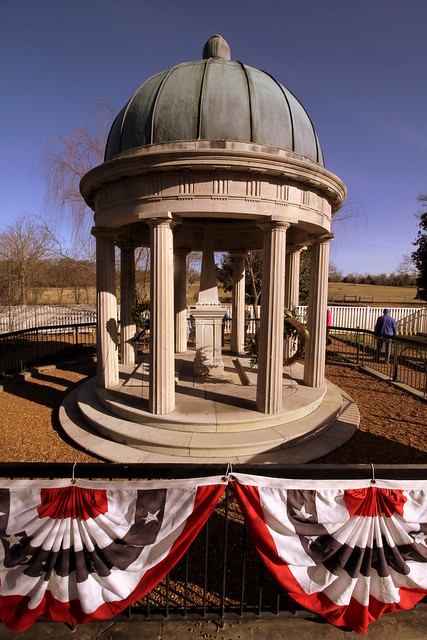
Gravesite of President Andrew Jackson

Gravesite of President Andrew Jackson

Tennesseean Andrew Jackson was the 7th President of the United States.
thehermitage.com/learn/andrew-jackson/

President Jackson and his wife Rachel are buried in the garden on the grounds of his mansion, The Hermitage.

Before Jackson was President, he was a military general. His most important victory was the Battle of New Orleans from the War of 1812. To commemorate this event, every year on January 8, the Tennessee National Guard lays a wreath at his grave site.

Gravesite of President Andrew Jackson

Monday, November 2, 2020

Tulip Grove - Nashville, TN

Tulip Grove - Nashville, TN

Tulip Grove is the 1836 house of Andrew Jackson Donelson, nephew of President Andrew Jackson. The home was designed by Joseph Reiff who also built the Hermitage. Donelson was a West Point graduate, foreign minister to Prussia, and unsuccessful candidate for Vice President in 1856. The home is close enough to President Jackson's Hermitage that it is part of the Hermitage grounds. You can see it as part of your Hermitage visit, although it is a bit of a walk.

From Wikipedia:
en.wikipedia.org/wiki/Tulip_Grove
While Andrew Jackson was still President in 1834, Andrew Jackson Donelson decided to build Tulip Grove in land close-by to the Hermitage. The house was completed in 1836 with the original name of "Poplar Grove." President Martin Van Buren suggested he rename it to Tulip Grove in 1841.

In 1858, Donelson sold the property to the parents of painter Mayna Treanor Avent (1868–1959), who grew up at Tulip Grove. Later, it passed through successive owners until 1964 when it was acquired by the Ladies' Hermitage Association.

Tulip Grove is representative of the antebellum Greek Revival style that was popular before the American Civil War. It consists of two main stories, a basement, and attic. The site was listed on the National Register of Historic Places in 1970.

Monday, September 14, 2020

The First Hermitage - Nashville, TN

The First Hermitage - Nashville, TN

Until President Andrew Jackson's final mansion was built, he lived in a two-story log cabin on his property for 15 years. After the new Hermitage was built, the original was disassembled and rebuilt into these two one-story slave quarters.

Friday, June 9, 2017

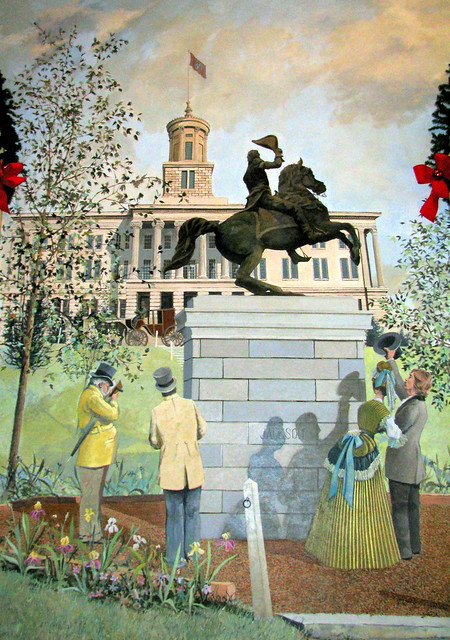
Opryland Ballroom Mural: Jackson Statue & Capitol

Opryland Ballroom Mural 4: Jackson Statue & Capitol

In Opryland Hotel's original ballroom area, the walls are painted to depict scenes from Nashville around the time of Tennessee's Centennial, in the late 1800's. To view the entire set of 8, Click Here.

The Tennessee State Capitol was designed by William Strickland, who also designed the U.S. Capitol. The building was finished in 1859. The Andrew Jackson riding statue was completed soon thereafter, and an identical statue was placed in New Orleans and one in Washington D.C. near the capitol.

Monday, July 11, 2016

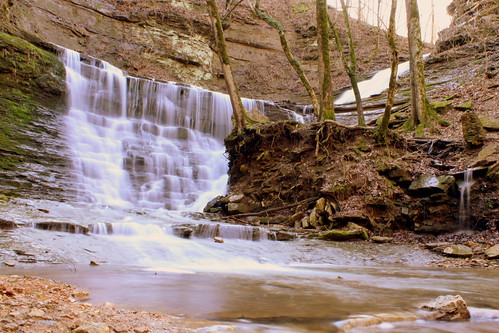
Jackson Falls

Jackson Falls (version 2)

When travelling along the Natchez Trace Parkway in Hickman County, near Milepost 404 is a pull off for Jackson Falls, one of the most scenic spots along the trace. The waterfall is named after Andrew Jackson who while still a general took the Natchez Trace and for all we know could have seen this place. All in all the falls are about 40 feet tall. It is in two parts, with the upper part as a cascade that flows at an angle where the stream makes a left turn and falls over a bluff.

from the marker at the top of the trail:
A steep trail (concrete sidewalk) 900 feet long takes you to a clear pool at the base of these falls. This trail descends to Jackson Falls a beautifully sculptured cascade that seems ageless but it isn't. For thousands of years before the falls existed Jackson Branch flowed into this high valley isolated from the Duck River below. Then in a classic case of stream piracy, the Duck River captured Jackson Branch. The flooding river and other erosional agents wore away at the bluffs, cutting a new channel through faults in the rock. At the site of Jackson Falls the diverted stream slips down into the Duck River Valley abandoning its former course.

Tuesday, November 3, 2015

In the News: Ten in Tenn: Hiram Masonic Lodge No. 7 - Franklin, TN

A few days ago, the Tennessee Preservation Trust released their 2015 list of endangered historical sites in the state. This week on the blog, we are talking about some of the properties on this list. Here is how TPT describes the list:
"The Tennessee Preservation Trust’s Ten in Tennessee Endangered Properties List Program is TPT’s strongest advocacy tool for the state’s most endangered historic sites. Each year, TPT seeks nominations for the “Ten in Tenn” from the public from each of Tennessee’s nine Development Districts."

You can also see past entries on their website here:
http://www.tennesseepreservationtrust.org/ten-in-tn/?ref=archive
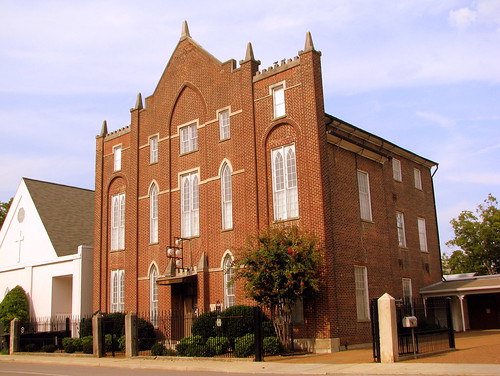
Hiram Masonic Lodge No. 7 - Franklin, TN

Hiram Masonic Lodge No. 7, a Gothic revival building constructed in 1823, is the oldest public building in Franklin, Tennessee. It houses Hiram Lodge No. 7, founded in 1809, and is the oldest Masonic Hall in continuous use in Tennessee. It was the location of the negotiation and signing of the Treaty of Franklin in 1830, in which the Chickasaw Indians sold their lands prior to being moved west to today's Oklahoma. Sitting president Andrew Jackson was a participant, the only time a U.S. President would journey to an Indian council for the purpose of making a treaty. The building was used as a hospital for wounded Union soldiers after the Battle of Franklin, during the American Civil War. It was declared a National Historic Landmark in 1973.

The brick building is three stories tall, five bays wide and five bays deep. The front roof line is gabled in the center, battlemented to either side of the center gable, and surmounted by five obelisk pinnacles. The windows of the first two floors at the front are elongated Gothic with 11 lights over eight set in semi-circular indented two-story brick arches. The central windows over the entrance are set in a Gothic indented arch of three stories. The windows of the third floor are rectangular, 4 lights over four. Plain rectangular windows are found along the sides and rear of the building--on the first two floors, 12 lights over 16; on the third floor, 8 lights over 8.

Still occupied by the Hiram Masonic Lodge No. 7, the group has actively sought education and funding for the preservation and restoration of the building, but does not have the funds for necessary structural repairs. Multiple additions made to the structure in 1856 and 1914 altered the stability of the walls, which has caused severe structural damage.

For more, read this article.

Friday, September 21, 2012

Jackson Falls

Jackson Falls

When travelling along the Natchez Trace Parkway in Hickman County, near Milepost 404 is a pull off for Jackson Falls, one of the most scenic spots along the trace. The waterfall is named after Andrew Jackson who while still a general took the Natchez Trace and for all we know could have seen this place. All in all the falls are about 40 feet tall. It is in two parts, with the upper part as a cascade that flows at an angle where the stream makes a left turn and falls over a bluff.

from the marker at the top of the trail:
A steep trail (concrete sidewalk) 900 feet long takes you to a clear pool at the base of these falls. This trail descends to Jackson Falls a beautifully sculptured cascade that seems ageless but it isn't. For thousands of years before the falls existed Jackson Branch flowed into this high valley isolated from the Duck River below. Then in a classic case of stream piracy, the Duck River captured Jackson Branch. The flooding river and other erosional agents wore away at the bluffs, cutting a new channel through faults in the rock. At the site of Jackson Falls the diverted stream slips down into the Duck River Valley abandoning its former course.

Wednesday, May 23, 2012

Christopher Taylor House - Jonesborough, TN

Christopher Taylor House - Jonesborough, TN

When visiting historic Jonesborough, this two story log cabin is located along Main St. from this historical marker:

About one mile southwest of this location, this log house was built in 1777 by this officer who was a veteran of the French and Indian War and a major in the American Revolutionary War. He is buried in the family cemetery nearby. Andrew Jackson lived here in 1788-89 wile practicing law in Jonesborough. The house was moved intact to this site in 1974 to preserve it from demolition.

Friday, March 23, 2012

Hiram Masonic Lodge No. 7 - Franklin, TN

Hiram Masonic Lodge No. 7 - Franklin, TN

Hiram Masonic Lodge No. 7, a Gothic revival building constructed in 1823, is the oldest public building in Franklin, Tennessee. It houses Hiram Lodge No. 7, founded in 1809, and is the oldest Masonic Hall in continuous use in Tennessee. It was the location of the negotiation and signing of the Treaty of Franklin in 1830, in which the Chickasaw Indians sold their lands prior to being moved west to today's Oklahoma. Sitting president Andrew Jackson was a participant, the only time a U.S. President would journey to an Indian council for the purpose of making a treaty. The building was used as a hospital for wounded Union soldiers after the Battle of Franklin, during the American Civil War. It was declared a National Historic Landmark in 1973.

The brick building is three stories tall, five bays wide and five bays deep. The front roof line is gabled in the center, battlemented to either side of the center gable, and surmounted by five obelisk pinnacles. The windows of the first two floors at the front are elongated gothic with 11 lights over eight set in semi-circular indented two-story brick arches. The central windows over the entrance are set in a gothic indented arch of three stories. The windows of the third floor are rectangular, 4 lights over four. Plain rectangular windows are found along the sides and rear of the building--on the first two floors, 12 lights over 16; on the third floor, 8 lights over 8.

Wednesday, November 9, 2011

TN State Capitol & Jackson Statue at night

TN State Capitol & Jackson Statue at night

Along Capitol Hill in Downtown Nashville, at night the Tennessee State Capitol is illuminated with Yellowish lights, while the base of the Jackson Statue is given a greenish appearance.

The Capitol was built in a Greek Revival design by Philadelphia architect William Strickland and completed in 1859.

The Jackson Statue was designed by sculptor Clark Mills and placed in 1880 with duplicates in DC and New Orleans.

Thursday, May 20, 2010

Andrew Jackson Statue, Washington, DC

Andrew Jackson Statue in D.C.

Yesterday, I posted a picture of the similar statue in Nashville. This statue is on the other side of Pennsylvania Ave, across from the White House.

The cast metal part of the statue is the same, but the bases are different, as the one in Nashville has the name JACKSON in large letters at the base, and this one is surrounded by cannons.

Wednesday, May 19, 2010

Andrew Jackson Statue, Nashville, TN

Andrew Jackson Statue, Nashville, TN

There are three of these President Jackson Statues in the US. This one is on the East side of the Tennessee Capitol on capitol hill. Another one is "across the street" from the White House in Washington DC. The third is in New Orleans. I had never seen that one, until President Bush spoke on TV in front of it in his Post-Katrina speech.

Tomorrow, I'll post the picture of the statue in Washington.