Home     Daily Blog     Galleries     Maps     Contact

Showing posts with label school. Show all posts

Thursday, May 19, 2022

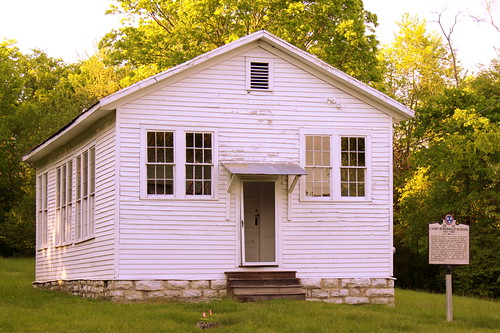
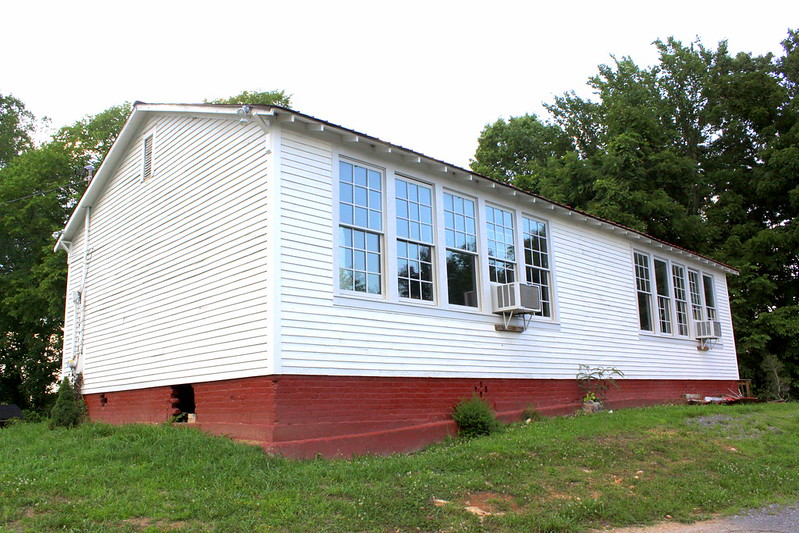
Asia (TN) Community School

Asia (TN) Community School

This building certainly needs repair. After it was no longer a school, it was converted to a basketball gym. Portions of the roof and the floor have fallen in.

en.wikipedia.org/wiki/Asia_School
Asia School is a former segregated school for African Americans in the Asia community of Franklin County, TN.

For many years, the Macedonia Primitive Baptist Church operated a black school on the Asia School site. In 1940, the church transferred the property to Franklin County, which assumed responsibility for the school. The current school building is a concrete-block structure that was completed around 1952. It was operated as a county public school for African-American children until 1961, when the county closed the school and returned the property to the church.

Four years after Asia School closed, Franklin County integrated its public schools. Asia School was listed on the National Register of Historic Places in 2011 for its significance as an example of a 20th-century African-American school in rural Tennessee.

For more info:
web.archive.org/web/20111015093515/http://www.tn.gov/envi...

Saturday, September 18, 2021

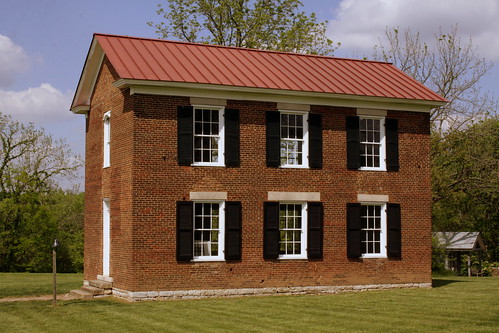
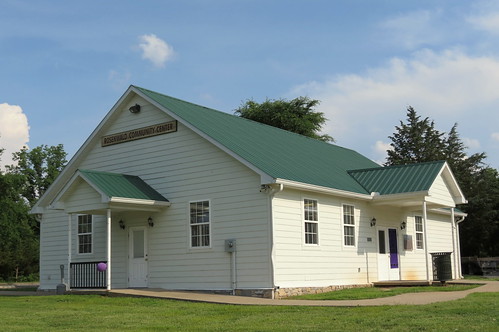
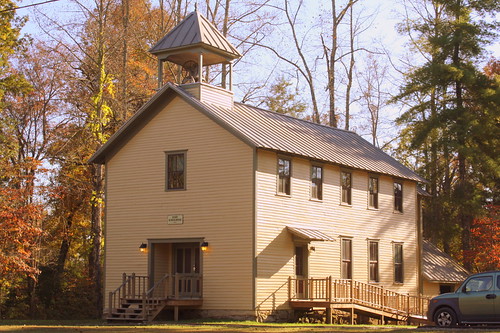
Raus School House

Raus School House

This school house in Raus was built in 1888. Now it serves as a community center. It was added to the National Register of Historic Places.

Raus is located along Smith Chapel road about 500 ft. from highway TN130. It is in Bedford County about a mile from Moore County.

Friday, January 1, 2021

Sam Houston Academy - Jasper, TN

Sam Houston Academy - Jasper, TN

The following description is taken from the TNTrailsandbyways.com Pie in the Sky Trail as stop #36:

This 1857 Greek Revival building just a block off the square has a rich history. It has hosted county meetings about secession and served as a hospital for both Federal and Confederate Civil War forces. Currently, the building is the home of Olive Branch Masonic Lodge #297.

Tuesday, September 15, 2020

Wilson Central High School Wall of Honor

Wilson Central High School Wall of Honor

Wilson Central High School is located south of Lebanon where Highway TN109 meets TN840. As you pass the entrance to the school, you see the Wall of Honor. Painted on a large rock face is a U.S. Flag, the words "Wall of Honor" and "We Support Our Troops", and alumni of the school who have served or are still serving in the U.S. Military.

Also highlighted on the wall is Michael L. Stansbery who was killed in action on 7/30/2010. Learn more about Army Spc. Stansbery HERE.

Monday, August 17, 2020

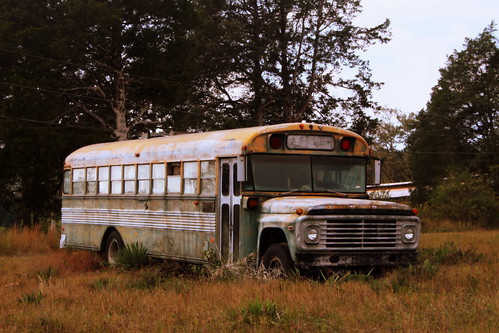
Abandoned School Bus

School's Out

This abandoned bus was seen in the Oak Grove area of Sharp's Chapel, TN.

Thursday, July 2, 2020

Childhood School of Tina Turner

Childhood School of Tina Turner

The Flagg Grove School was the childhood School of Tina Turner. The school has been preserved and relocated to be a Tina Turner Museum, and it's free to visit. Inside the school museum are several of Turner's performance outfits, gold records and photos. A portion of the inside is recreated to look like the school would have appeared when she was a student.

Inside Tina Turner's Flagg Grove School

This is one of the exhibits at the conveniently located West Tennessee Delta Heritage Center. It is just off Interstate 40 at exit 56. The free museum has several exhibits of West Tennessee including: Tina Turner's School, Sleepy John Estes home, West TN Music, Cotton, Hatchie River and Lincoln exhibits.
westtnheritage.com/

Tina Turner Museum / Flagg Grove School

Monday, June 29, 2020

Hume-Fogg High School front entrance - Nashville

Hume-Fogg High School front entrance - Nashville

Hume-Fogg High School is a public academic magnate school located in downtown Nashville. The five-story Tudor Revival building opened in 1912 when two schools merged. The school building was added to the National Register of Historic Places in 1974. For more information:
en.wikipedia.org/wiki/Hume-Fogg_High_School

A good friend of mine is a Hume-Fogg alumnus. I showed him this picture and he said that sometimes going to class felt as daunting as the photo represents.

Friday, May 29, 2020

Lebanon, TN City Hall - Castle Heights

Lebanon, TN City Hall - Castle Heights

From Wikipedia:

Castle Heights Military Academy was a military academy in Lebanon, Tennessee.
The Academy was founded as Castle Heights School in 1902. In 1918, it became a military preparatory school. The school ceased operations in 1986 in the face of declining enrollment. Its buildings have been restored and now the main building serves as the Lebanon City Hall, Lebanon Museum and History Center.

This building is stop #13 on the Historic Lebanon Driving tour. Here is the text from that brochure:
David E. Mitchell and I.W.P. Buchanan opened the Castle Heights School in 1902. Mitchell had just been named president of Cumberland University where Buchanan was professor of mathematics. Their idea was to create an environment unlike any other preparatory school. Students who did not live in town were required to board at Castle Heights.

The school had ninety-four boarding students and fifty-nine day students its first year. In 1917, the school changed into a military academy. Castle Heights Military Academy (CHMA) closed its doors forever August 13, 1986.

For eighty-four years the school had shaped boys, and girls beginning in 1973, but was not able to carry on, hindered by a lack of enrollment and adequate financing.

The remaining buildings of the former campus were added to the National Register of Historic Places as a Historic District in 1996.

Friday, April 24, 2020

Lindsley Hall - Nashville, TN

Lindsley Hall - Nashville, TN

This building on the National Register of Historic Places is now part of the Richard H. Fulton Campus of city government buildings. Before that, the building was the Nashville Children's museum, which became the Cumberland Science Museum (then Adventure Science Center) in 1974. For the remaining history, here is the text of the marker:
The literary building on the campus of the University of Nashville opened in 1854. The structure was designed by Adolphus Heiman, a local architect and stonemason who immigrated to Nashville from Prussia in 1837. The Gothic Revival building used local limestone and served as faculty office space, student housing, and classrooms. The university was both a highly-respected medical college and literary academy from its founding in 1826 to the eve of the Civil War. Because of financial problems, however, after 1855 the school shared the campus with the Western Military Institute.

During the Civil War (1861-1865), the Literary Building was used as both a Confederate and Federal hospital. None of the structures on campus were damaged as a result of war.

The University transitioned to a prep school in 1867 (Montgomery Bell Academy) before eventually the facilities became the home of Peabody Normal School. The campus was closed in 1915 when Peabody moved to their present site near Vanderbilt University. Today, only the Literary Building remains and serves as offices for Metro Nashville government.

Monday, April 13, 2020

Boiling Spring Academy - Brentwood, TN

Boiling Spring Academy - Brentwood, TN

Boiling Spring Academy is a resotred one room schoolhouse in Brentwood, TN that dates back to 1832. The school was built on land that also contains several old Indian Mounds.

The first classes were held at this private school in 1833. In 1887, the building became a public school. Around 1900, the building was also used as a multi-denominational church, and what had been the main door became the middle window, with the door moving to the side. It's use as both a school and a church stopped in the late 1910s as the Primm family, who owned the surrounding farmland, used the building to store hay, corn and tobacco.

In 2003, the Primm family donated the land to the city of Brentwood, who made this Primm Historic park after a year of renovations. The park is along Moore's Lane (TN441) near the intersection of Wilson Pike (TN252), however the gate is often locked. The park is also accessible via the city Bicycle Greenway system. The Academy is listed on the National register of Historic Places.

For the whole story, read the brochure PDF here:
www.brentwood-tn.org/Modules/ShowDocument.aspx?documentid...

Friday, April 3, 2020

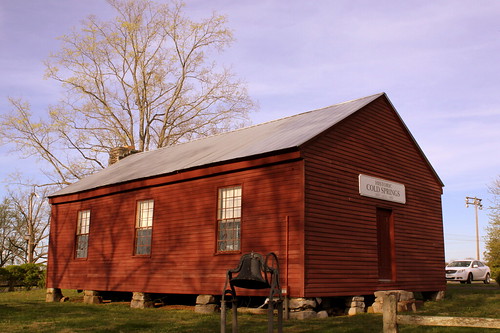
Cold Spring School - Portland, TN

Cold Spring School - Portland, TN

From a nearby Tennessee Historic Commission marker:
Cold Spring School - circa 1857-1933
2.8 miles northeast is the site of Cold Spring School. It was built on land donated in May 1857 by Thomas Baskerville for a school and meetinghouse. Early in the Civil War, it was used by Camp Trousdale as a military hospital. There, in 1866, David Lipscomb organized the Portland Church of Christ. Landowners Jim and Bill McGlothlin gave the schoolhouse to the citizens of Portland for a museum of local history. In September 1975, it was relocated to Richland Park.

Tennessee Civil War Trails Marker at Richland Park:
In May 1861, the Tennessee General Assembly passed legislation to raise and equip the Provisional Army of Tennessee and train the units at camps throughout the state. Camp Trousdale was established—initially at Richland (present-day Portland)—as the main concentration point for companies formed in Middle Tennessee. The camp was named for former governor William Trousdale of Gallatin. Gen. Felix K. Zollicoffer (1812-1862) was its first commander, with his headquarters at the home of Thomas Buntin near the present Maple Hill Cemetery.

Because of a lack of potable water, Camp Trousdale moved in June to an area of wide rolling fields near the one-room Cold Spring School that Thomas Baskerville had constructed in 1857. The school served as a regimental hospital. Soon more than 6,000 men were drilling in the camp, and some of the sick were treated at the school building. Later, Camp Trousdale relocated to present-day TGT Road, again because of water contamination. The only barracks in the state that housed Confederate troops were built there, then razed in February 1862 before Union forces arrived and occupied the area.

Federal troops under the command of Lt. Col. Gustavus Tafels, 106th Ohio Volunteer Infantry Regiment, subsequently fortified the Louisville and Nashville Railroad, constructing Fort Mitchell to guard the nearby trestle. Fort Smith, named for Col. George P. Smith, 129th Illinois Infantry, served as a temporary railroad to receive and ship Union supplies by wagons to Nashville.

Here is a third marker in front of the school:
Cold Springs, a rural one room school, was built near cold water springs on the Thomas Baskerville farm, near Mitchellville, Northern Sumner County. During the Civil War the school was a hospital for Confederate troops quartered at Camp Trousdale.

Howard McDowell, former student, mobilized efforts to move and restore the building. Structure donated by Jim & Bill McGlothlin. School moved into Richland Park in September, 1975.

Official agreement signed by City of Portland, McGlothlin families, and Highland Rim Historical Society, November 1, 1975.

Wednesday, September 6, 2017

Rosenwald School Replica (Community Center) - Smyrna, TN

Rosenwald School Replica (Community Center) - Smyrna, TN

Located in Hilltop-Rosenwald Park in Smyrna, this community center was built to look identical to the Rosenwald School that had been at this location decades earlier. The park is full of markers discussing local African-American history.

Julius Rosenwald was the owner and president of Sears, Roebuck & Co. and established the philanthropic Rosenwald Fund. This fund was used to build schools in under-served African-American communities in the south. From 1917 and into the 30's, the fund helped build 354 schools. Very few of these schools still remain. For more info on these schools: en.wikipedia.org/wiki/Rosenwald_School

Saturday, December 10, 2016

Cairo Rosenwald School

Cairo Rosenwald School

This historic school house has worn down a little bit, but I think the building looks happy.

The historic marker is seen next to the school in the picture, but it must have originally been located at the intersection of highway TN25 and Ziegler Fort Rd. The school is down the road from the entrance to Bledsoe Creek State Park in Sumner County. Here is the text of the marker:

Located 2.6 miles south of here is the Cairo Rosenwald School. Completed in 1923, it provided educational opportunities for African-American children until 1959. Funding for the school's construction was provided by the Rosenwald funds. The architectural plan followed the standard Rosenwald School design for a one-teacher African-American school. Closed in 1959 due to the consolidation of schools, this building has remained in use as a community center. The Cairo School building is listed on the National Register of Historic Places.

Tuesday, February 24, 2015

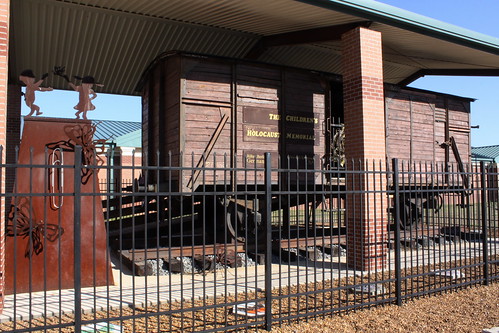
The Children's Holocaust Memorial - Whitwell, TN

The Children's Holocaust Memorial - Whitwell, TN

The small southern town of Whitwell made national headlines when a small school project grew into a major tribute to tolerance and a remembrance for the millions who died in Nazi concentration camps.

Whitwell is a small town in Marion County, TN. After the coal mines closed, the area became quite poor. What happened next may help change the perception of what rural life in the south is all about.

Without any indication of what was to come, it started simply enough in 1998 in a Whitwell Middle School History class discussing World War II. The teacher discussed how six million Jews were slaughtered in the Nazi camps and a student asked how big Six Million is. In a town of just a little over one thousand people, it's hard to imagine just how big six million really is. One student doing research discovered that people from Norway wore paper clips as a symbol of resistance against the Nazis.

The teacher thought it would be an interesting exercise to see if they could gather a few paper clips as a small sampling of how big six million could be. The students began a letter writing campaign asking various people to donate paper clips to the project. After a few thousand had come in, some reporters came to visit the school to see what was going on. Those reporters told about the school's project and told the story nationally. A couple of years after they had started, over 29 Million paper clips had been sent to the school.

The school began to ponder what they should do with all of the paper clips. A couple of Jewish reporters who stayed in contact with the school searched Germany and found a vintage rail car which had been used to transport Jewish captives to the camps. The railcar was transported by boat to Baltimore and CSX delivered the car to Chattanooga in 2001.

Many students and townspeople came together to make the memorial site a long-lasting tribute. 11 million of the paper clips were placed inside the rail car, remembering not only the Jews but all of the other groups that were also killed in the Nazi camps. This memorial was dedicated on Nov. 9, 2001.

A documentary was filmed about the project, a full length movie titled "Paper Clips." I highly recommend everyone interested in this memorial should see that film.

Friday, November 28, 2014

Rugby School

Rugby School

Rugby is a small community along the Cumberland Plateau in Morgan County, founded by British Immigrants in 1880. The Rugby Colony was designed to be a utopian community, but the design failed in less than a decade. Still a few townspeople and their descendants lived in the area over the next several decades. In the 1960s, residents, friends and descendants of Rugby began restoring the original design and layout of the community, preserving surviving structures and reconstructing others.

The Schoolhouse was originally built in 1880 and reconstructed in 1907.

Friday, August 22, 2014

Free Hills Rosenwald School

Free Hills Rosenwald School

Free Hill is a community in Clay County, TN. It is an African American community established before the Civil War. The original inhabitants were the freed slaves of Virginia Hill, the daughter of a wealthy North Carolina planter. After purchasing 2,000 acres of isolated hilly land, Hill freed her slaves and turned the property over to them.

Julius Rosenwald was the owner and president of Sears, Roebuck & Co. and established the philanthropic Rosenwald Fund. This fund was used to build schools in underserved African-American communities in the south. From 1917 and into the 30's, the fund helped build 354 schools. Very few of these schools still remain. For more info on these schools: en.wikipedia.org/wiki/Rosenwald_School

The Free Hills Rosenwald School was used from approximately 1925 to 1949. The structure, which is believed to be one of only about 30 Rosenwald schools still standing, was placed on the National Register of Historic Places in 1996. The school is also stop #56 on the TN Trails and Byways Ring of Fire trail


Sunday, September 15, 2013

Alpine Institute - Christ Church Presbyterian

Alpine Institute - Christ Church Presbyterian

The Alpine Institute was a Presbyterian mission school located in Overton County, TN. Operating in one form or another from 1821 until 1947, the school provided badly needed educational services to children living in the remote hill country of the Upper Cumberland region. In 2002, several of the school's surviving structures were added to the National Register of Historic Places as a historic district.

John Dillard (1793–1884), a minister affiliated with the Cumberland Presbyterian Church of Southern Appalachia, established the Alpine School atop Alpine Mountain in 1821 and expanded the school in the 1840s. The school was burned by bushwhackers during the Civil War and again by the Ku Klux Klan in the years after the war. The school was re-established in 1880 at its current location at the base of Alpine Mountain, and under the leadership of future Tennessee governor A. H. Roberts continued to thrive into the following decade. In 1917, the better-funded Presbyterian Church assumed control of the school and helped it develop into one of the state's most competitive rural schools.

The Alpine Institute was located along Highway TN52 (Jamestown Highway) in the Alpine community, just over 10 miles east of Livingston. This community is situated in a valley carved by Nettlecarrier Creek (which empties into the Obey River just east of Alpine), and is surrounded by high ridges on all sides, most notably the 1,826-foot Alpine Mountain, which rises prominently to the south. A one-lane road, Campus Circle, accesses the church and adjacent buildings.

While Alpine Institute's main school building no longer stands, several important structures associated with the school have survived. The Christ Church Presbyterian (a Gothic Revival-style church, which was completed in 1934) is well-maintained and still used for religious services. The school's gymnasium is now used as a community center, and the manse is still in use as a residence. Other surviving structures include the shop building and a dairy barn. The gymnasium, church, and shop building were all built using the same type of native stone.

Alpine Institute - Christ Church Presbyterian

Friday, March 29, 2013

Parham School House

Parham School House

OK, this kind of picture deserves to not be taken with a guardrail in the foreground, but there was nowhere to park and this was a drive-by shooting (in a camera sense.)

This one room schoolhouse was built in 1919 and typical of the types of schoolhouses in the area.

This is stop #22 on the TNTrailsandByways.com "Old TN Trail"

Sunday, March 24, 2013

Bradley Academy - Murfreesboro, TN

Bradley Academy - Murfreesboro, TN

The Academy has a history dating back 200 years, and was the first school in Rutherford County. The first building was a log cabin on the land of Revolutionary War officer John Bradley. A few years later, a brick building was built on Main Street in Murfreesboro.

James K. Polk attended this well-known institution of the time. Also attending the school at that time was John Bell, a long-time opponent of Polk, U.S. Speaker of the House and Presidential Candidate.

Bradley Academy then merged and moved in with nearby Union University in the 1850s, leaving the building vacant for about three decades. In 1884, the Bradley Academy served a new purpose, it was the first black school in America. Over the next few years, enrollment continued to grow, with a need for expansion.

This building seen here was built for the expanding school in 1917. By 1955, city school integrated and no classes were held here anymore. By 1990, Friends of Bradley Academy sought to preserve the school's history and heritage. Today, the 1917 Academy building is a museum and is listed on the National Register of Historic Places.

For more info:
bradleymuseum.com/welcome.htm
www.murfreesboropost.com/bradley-academy-dates-back-to-18...

Tuesday, August 21, 2012

Postcard Tuesday: Hume-Fogg High School


Located in downtown Nashville at the corner of Broadway and 8th Avenue, is this historic high school with a look of a castle. Today, Hume-Fogg is Nashville's magnate public school. I have a couple of close friends that attended here. This card was dated 1926.